



What is Innocent Spouse Relief? How to Avoid Paying for Your Ex’s Tax Mistakes
On: December 11, 2025
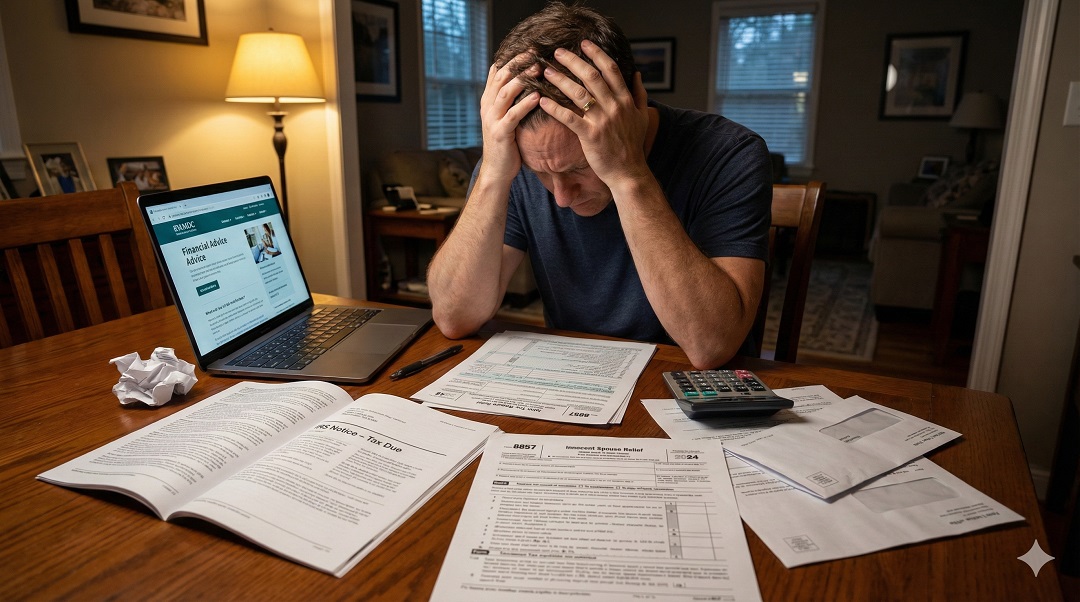
Divorce in itself is one of the most stressful occurrences in life. However, to most of them, the stress does not settle once the papers are signed. Many a bad surprise comes several months or years later when someone gets an IRS notice that they have a tax bill to pay, or that the tax bill was to be paid by their former spouse.
Now and again, at Leading Tax Group, we can hear the same panicked scream: I was informed that my ex will pay the taxes based on my divorce decree. Why is the IRS coming after me?”
The solution is a hideous legal principle called Joint and Several Liability. But you still do have a choice. IRS has a lifeline known as Innocent Spouse Relief that is available in the case of such a situation. This is all you can do to ensure you are not the target of tax errors made by your ex.
The Trap: Understanding Joint and Several Liability
By signing a joint tax return (Form 1040), you are signing a legally binding agreement with the federal government. According to this contract, the taxation liability is imposed on 100 percent on each spouse.
This implies that in case your former spouse was reporting low income, taking fictitious deductions, or not paying the bill at all, the IRS is legally allowed to collect the full amount of the debt on his behalf. It does not matter to them who made the mistake and who earned the money.
More importantly, your divorce does not tie the hands of the IRS. Granted, the judgment of a judge in the family court authorized your ex to pay all tax arrears; that is a civil contract between you and your ex. It does not prevent garnishment of your wages by the IRS, or pretty nailing of your property by the IRS.
The Solution: Three Types of Relief
Should you ever happen to be in this nightmare situation, you can plead to be relieved through the filing of IRS Form 8857. The three types of relief are different, and each one is subjected to particular demands.
- Classic Innocent Spouse Relief: This is the most popular type of relief. It is used when your spouse mismatched on your joint return, which could be of omitting the income or taking a false credit for which you had no idea.
Eligibility: You will have to demonstrate that at the time you signed the return, you did not know and lacked any reason to know of the error. The IRS will examine your education, participation in family money, and whether you observed excessive expenditure that did not reflect the actual amount of income you were reporting.
- Separation of Liability Relief: In this type of settlement, you share the tax burden with your former spouse. You have no liability for the full amount of the bill, but only to the amount of tax you pay on your own income, and diminishing to affixations.
Eligibility: You should be divorced, legally separated, or widowed, or have not resided in the same household as your spouse within 12 months before the filing of the request. This represents a pure math computation as opposed to Classic religion to separate your money and that of your business partner.
- Equitable Relief: This should be your backup in the event you fail to qualify the initial two alternatives. Equitable Relief applies frequently where the tax return was right (that is, you were aware of the income), it is not the case that the tax was not paid.
Eligibility: The IRS examines the fairness of the situation. Some of the factors involve your economic hardship in case of being compelled to pay, victim of spousal abuse, and whether or not you had a reasonable belief that your spouse was going to pay the bill.
How to Apply and What to Expect?
Its application to relief entails a high-stakes legal process. You have to complete the Form 8857 (Request for Innocent Spouse Relief) (4).
- The Deadline: You are usually given two years from the first attempt made by the IRS to collect the tax on your date you will file this form. Do not wait.
- The Notification: It is important to note that, according to the law, the IRS has to call your spouse or ex-spouse to notify them that you have applied to seek relief. They can be included in the process, and they can give information that may at times cause disputes.
- The Freeze: Collection actions towards you are often held in most instances as the IRS processes your appeal.
Why You Need Professional Representation?
It is usually about your presentation of a lack of knowledge that makes you win an Innocent Spouse case. The thinking of the IRS will be that you ought to have known about the mistakes since you have signed the returns.
Our lawyers at Leading Tax Group understand how to compile the evidence required, which may be bank records, medical records, or evidence of domestic abuse, to form a compelling story that meets the heavy legal burden of the IRS. You are not supposed to pay to make mistakes that are not your fault.
Frequently Asked Questions (FAQ)
Does my divorce decree protect me from the IRS?
No. This is the most threatening of all divorce tax law misunderstandings. A divorce order is an agreement between you and your former spouse, but it has no authority with the IRS. The IRS is able to collect a hundred percent of the joint debt in case your name appears on the joint return.
What if I knew about the income but didn't know my spouse wasn't paying the tax?
You still can be eligible, but probably only to Equitable Relief. Officer Classic “Classic” Innocent Spouse Relief usually has the condition that you were unaware of the mistake (the understatement). In case of some correction in the returns, but the bill was not paid (an underpayment), you will have to demonstrate that you reasonably believed your spouse would pay the debt, and that holding it against you was not fair.
Will the IRS tell my ex-spouse that I applied for relief?
Yes. Both the IRS and the non-requesting spouse (your ex) are required by law to be informed about the claim and given a chance to offer information about it. This is sometimes threatening, particularly when it comes to domestic abuse. Nevertheless, the IRS is not going to provide them with your personal contact details (such as your new address).

 800-900-4250


