



Sole Proprietorship, LLC, Or S Corp, Which One Is Profitable for Business People?
On: November 26, 2025
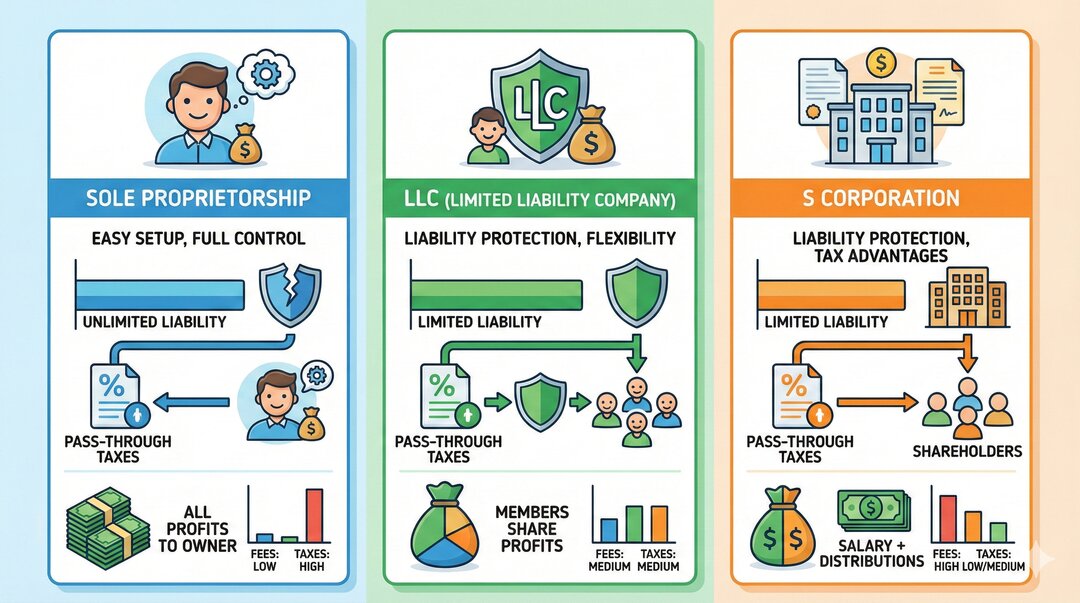
The idea of opening a business in California is thrilling; however, it can be frightening due to the high tax level that is typical of the state. The choice of business structure is one of the most important decisions that you will make. It is not only a question of liability but a direct axe on your tax bill.
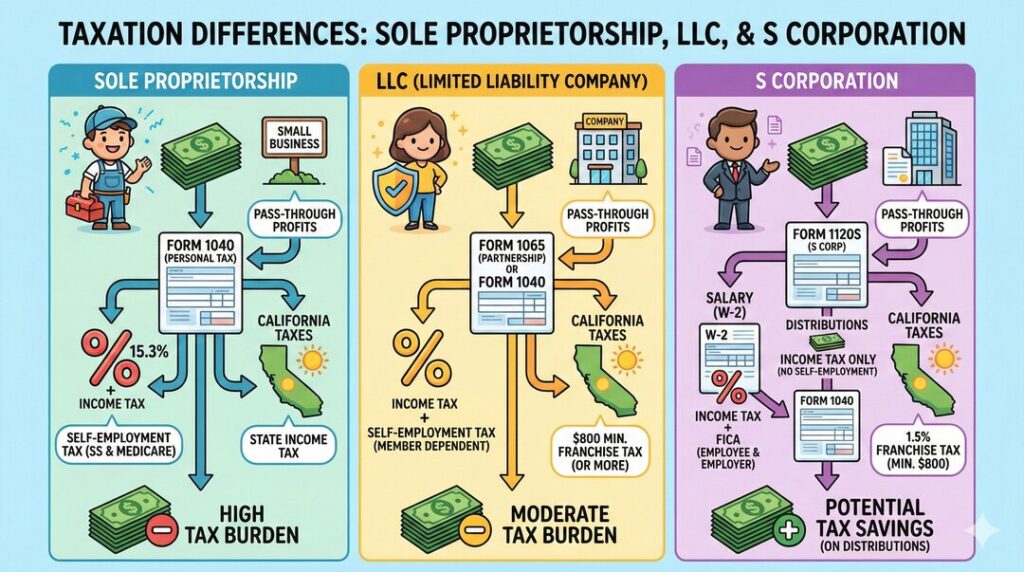
But who gets you the best tax break in California? The response, disappointingly enough, is ‘it depends.’ However, it is possible to identify an appropriate fit to your business by simplifying the tax treatment of Sole Proprietorships, LLCs, and S Corporations.
What about Sole Proprietorship?
A sole proprietorship is not its own legal entity; it is merely you out there doing business. The default is when you commence selling products or services without any formation paperwork.
Understand the Tax Breakdown
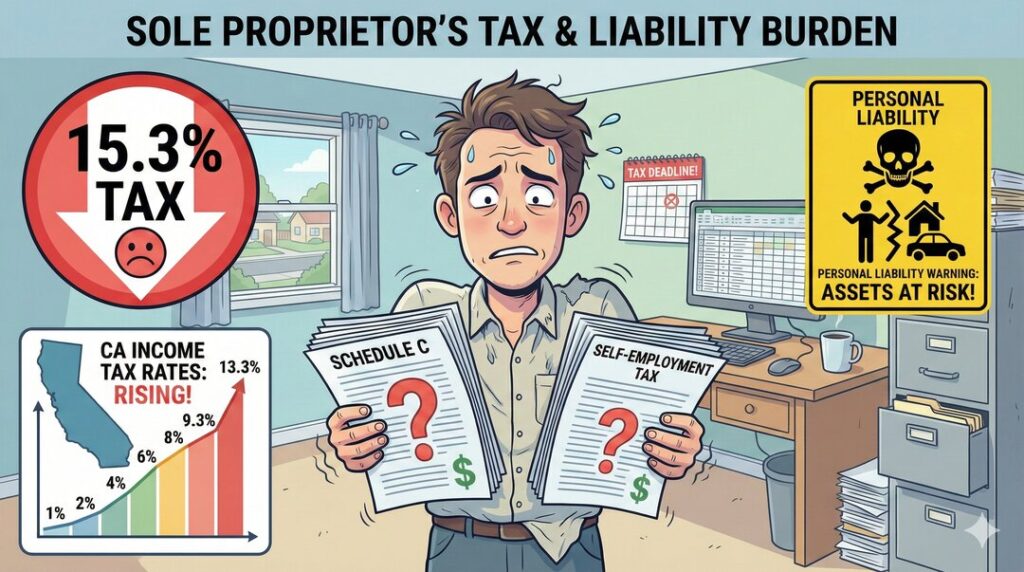
All business profit is reported on your personal tax filing (Schedule C), to which income tax and self-employment tax (now 15.3% to Social Security and Medicare) are due.
- State Income Tax: Profit of the business is subject to your personal income tax rate, which is up to 13.3% in California.
- None/No California Annual Fee/Tax: This is the major point of difference. The California LLC fee or the S corporation franchise tax is not paid in sole proprietorships.
You pay the maximum self-employment tax on all the profit, and also have the very high progressive rates of California income tax. They are also not liable- your personal assets will be at stake.
We Need to Know About LLC
The reason why the Limited Liability Company (LLC) is so popular is that it allows you to protect your personal property against business liabilities without the formalities of a corporation. Its tax treatment, though, bears a California twist.
Tax Implications
It is taxed as a so-called disregarded entity by default- just like a sole proprietorship. The profit goes to your own personal profit and is liable to self-employed tax.
a) Federal Taxes (Multi-Member LLC)
The default would be taxed as a partnership, where the profit/loss would be divided among the members, and the self-employment tax would apply.
b) California Taxes (The " LLC Tax)
The big one. The state of California has two compulsory expenses on the LLCs:
c) Annual Franchise Tax
The amount is a flat 800 a year, which you have to pay even when operating at a loss.
d) Gross Receipt Fee
This is a sliding scale fee based on what you make in California (not profit!). It begins at 0 when the revenue is less than 250,000, and it ends at 11,790 when the revenue is above 5 million.
LLC offers very important protection on liability, but has a minimum tax liability of 800 per year. Gross receipts are likely to be heavy for businesses with high revenues and low margins. The hit on the self-employment tax is still a significant expense.

Finally, Know about S Corporation
An S Corporation is not a legal entity, but it is a tax election. The way you do it is first to create a corporation (or LLC) and submit Form 2553-2 to the IRS to make the election of an S Corp. It is strong because it does not impose self-employment tax on part of your income.
Tax Reasoning
1. Federal Taxes
The business typically does not pay any income tax. The profit and loss is transferred to shareholders. The tax saving is through dividing your income into.
2. Salary
You will have to pay yourself a reasonable salary for the work you do. It will be liable to payroll taxes (equivalent of self-employment tax, divided between the company and you).
3. Distributions
The balance of profit may be distributed in such distributions that are not subject to self-employment tax. And this is where the savings can be achieved.
California Taxes
1) Franchise Tax
There is an annual flat Franchise Tax of $800 per year (similar to an LLC).
1) 1.5% Net Income S Corp Tax
2) No Gross Receipts Fee
S Corps do not pay the California gross receipts fee, as is the case with LLCs.
There are substantial self-employment tax advantages to be realized by the S Corp, but at a cost: added complexity and costs (payroll processing, filing more complex tax returns, Form 1120-S), and the required payment of 800 plus 1.5% of the income tax.
Actionable Tips for Business People
- Keeping it simple helps many entrepreneurs start their business as a sole proprietorship or single-member LLC to keep costs low. At the point of having a consistent profitability of more than 70,000-80,000 above profitability, it becomes economically viable to consider the S Corp election.
- IRS demands that your salary should be what a similar business would pay to have your services. Make it too low, and you will risk an audit and penalties. To calculate this number, consultation should be performed with a professional.
- Not a corporation to become an S Corp! Or, you may create an LLC so that you have the flexibility in the legal system and file Form 2553 to be taxed as an S Corp so that you can have the best of both worlds.
It is a long-term decision: a fundamental choice. The best thing one can do is to meet with the CPA or tax attorney in California. They are able to do the calculations on your particular case and see that you are not putting money out there or leaving you open to liability at the door.
FAQ
1) Is the $800 LLC fee tax-deductible?
Yes, the franchise tax amounting to 800 a year will be a deductible business expense on your federal and state income tax returns. It is a deduction to your total taxable income, but not a deduction to the amount of state tax due.
2) What could be a reasonable salary for an S Corp?
The IRS demands payment that is equal to what another business would pay in case of the same services. To a sole owner, this can usually be a salary of 40-60% of the net profit of the business, well deserved, as reflected in your position and the industry practice.
3) Is it possible my LLC could be taxed as an S Corp?
Absolutely. This is a common strategy. You create an LLC due to the flexibility of the law and submit IRS Form 2553 to choose S Corporation tax treatment. This is a combination of liability coverage and a possible tax deduction on self-employment.
4) Does a Sole proprietorship pay the California fee?
No. Sole proprietorships and general partnerships do not pay the California $800 yearly franchise tax. This is an important, initial cost saving, but without any individual liability protection.
5 Can an S Corp stop making financial sense?
The expense of payroll and tax preparation may exceed the savings in self-employment tax in case the other cost exceeds the net profit of your business. To most, this level is approximately $50,000-60,000 of net profit in a year.

 800-900-4250


