



Form 1099-DA and the 2026 Crypto Crackdown: What to Do When Your Tax Return Doesn’t Match What Your Exchange Reported
On: November 5, 2026
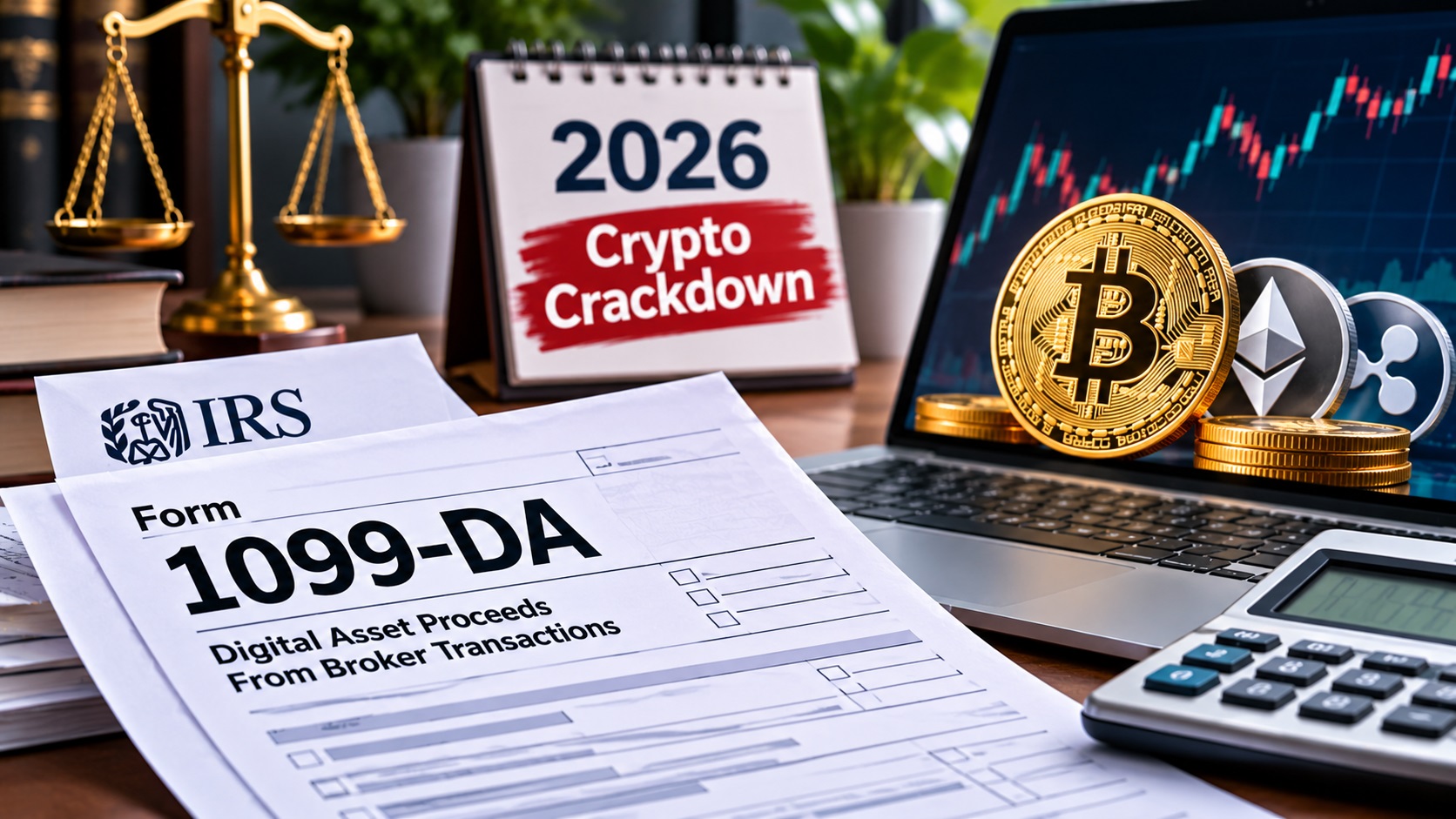
Table of Contents
- What's New with Form 1099-DA?
- Scrutiny of Cryptocurrency Taxes for A Variety of Reasons
- What Transactions Must Be Reported?
- Possible Reasons Why Your Tax Return May Not Be Accurate in Reflecting Form 1099-DA
- Knowing your Cost Basis and Capital Gains
- How to Match up Form 1099-DA with your Tax return
- If Your Exchange Gave You the Wrong Form 1099-DA?
- What If the IRS Reports a Reporting Mismatch?
- If You Get A Notice From the IRS:
- Don't Overlook Staking Rewards, Airdrops, and DeFi Transactions
- Some Useful Advice for Crypto Tax Reporting Issues
- Professional Tax Representation Can Be Very Helpful
- FAQ
Investors of cryptocurrencies are in a whole new phase of tax reporting. The IRS’s new Form 1099-DA is an information reporting form meant to provide the IRS with visibility into the sale and exchange of digital assets, starting with transactions in 2025. For investors who will be filing their 2025 tax returns next year (2026), this implies that cryptocurrency exchanges will be reporting information on the transactions to the IRS.
The new reporting system is designed to make it easier for the Government to get the information it needs from companies to ensure they pay the correct tax, but it also poses problems. Gross proceeds from the exchanges may not include full cost-basis data, and investors could have acquired assets from various exchanges, moved coins between wallets, or executed trades on decentralized exchanges.
If the numbers on Form 1099-DA don’t match a taxpayer’s record, the IRS may notice the discrepancy. Knowing what to do with the new regulations and reconciling conflicting information is crucial to preventing needless tax assessments, fines, and interest.
What's New with Form 1099-DA?
Qualifying digital asset brokers must submit statements to the IRS, along with certain digital asset transactions, in a 1099-DA, Digital Asset Proceeds From Broker Transactions.
The reporting obligation is the result of amendments made by the Infrastructure Investment and Jobs Act and subsequent regulations by the Treasury.
The implementation is being phased in:
- The gross proceeds of the reported digital asset dispositions are typically reported on the 2025 transactions.
- 2026 transactions: In 2026, brokers will be required to report gross proceeds and cost basis of covered digital assets, with certain exceptions.
- Noncovered assets: Brokers don’t have to report cost basis, but they can.
It is especially critical for those investors who file their 2025 tax returns in 2026. They can report proceeds on their Form 1099-DA but not the original purchase price. The taxpayer does not have a zero cost basis, and the entire reported figure doesn’t necessarily represent taxable profit.
Scrutiny of Cryptocurrency Taxes for A Variety of Reasons
The decentralized exchanges, private wallets, and international cryptocurrency markets have made it hard for tax authorities to keep track of cryptocurrency transactions for several years.
Investors would be able to transfer assets between platforms without creating a “consolidated transaction history. Others also had some of the wrong activities that resulted in taxable events.
One solution to this reporting loophole is the 1099-DA, which mandates that certain brokers report certain transaction information to the IRS.
These reports will enable the agency to look for discrepancies between the amounts reported by the agency and the information provided on individual tax returns.
Having a Form 1099-DA, however, doesn’t guarantee that a taxpayer is obligated to pay more taxes or to have committed a breach of tax laws. It is a report of tax information that must be matched to the taxpayer’s actual transaction and actual adjusted cost base.
What Transactions Must Be Reported?
Commonly, a Form 1099-DA will be issued with respect to qualifying broker activities of digital asset dispositions. These include:
- Trading Bitcoin, Ethereum, or other cryptocurrencies for U.S. dollars.
- Converting a cryptocurrency into another one.
- Making transactions using cryptocurrencies.
- Disposing of digital assets to pay transaction fees.
- Some NFT sales and stablecoin transactions.
It’s important to note, however, that not all cryptocurrency transactions are taxable.
For instance, if you move Bitcoin from one personal wallet to another wallet you own, you will generally not need to pay any taxes. But the tax implications of using cryptocurrencies to pay network fees or other services may be different.
Likewise, any gain or loss on cryptocurrencies is not generally recognized by simply buying and holding the asset. The tax consequences are realized in a taxable disposition or an income-generating event.
Possible Reasons Why Your Tax Return May Not Be Accurate in Reflecting Form 1099-DA
A major drawback of the new reporting framework is that an exchange of cryptocurrencies is not always aware of all of the details regarding an investor’s initial transactions.
Let’s take an easy one, for instance:
The investor buys $20,000 worth of Bitcoin from Exchange A, moves it to their private wallet, and then deposits it to Exchange B. At the end of the day, the investor will finally sell the Bitcoin for $32,000.
With the original $20,000 purchase price unknown, Exchange B can report the $32,000 sale proceeds in the financial statement without any issue.
The investor may report a $12,000 capital gain on their tax return, but the exchange may report the gross proceeds as $32,000.
A difference is not necessarily due to tax evasion. It could just be due to a lack of cost basis.
Some other common causes of differences are:
- Deposit/withdrawals as separate sales: If deposits and withdrawals are not treated correctly, this could lead to duplicate transaction records appearing when moving between exchanges.
- An exchange might not be aware of the acquisition price of assets acquired on another exchange.
- Transaction fees: Trading commissions, qualifying gas fees, and other transaction fees may impact proceeds or adjusted basis.
- Wrong transaction times: The times of the transactions can vary depending on the exchange, especially if they are executed across different time zones.
- Multiple wallets: Investors with hardware wallets, private wallets, and multiple exchanges may not be able to keep a complete track record.
- Different cost-basis methods: Lots selected on different platforms may be calculated with different methods, leading to different gains.
Knowing your Cost Basis and Capital Gains
The cost basis of digital assets is usually the amount paid to purchase the asset, minus any transaction fees or other tax considerations.
The investor will typically report the gain or loss on Form 8949 and Schedule D, whichever applies.
There is also a time dimension:
- Short-term: Assets that are held for one year or less typically generate short-term capital gains or losses.
- Long-term: Those assets that are held for a period exceeding 1 year are usually treated as long-term capital assets.
The federal tax rate will vary depending on the individual’s income and situation.
It’s also important to note that there are deduction and carryover restrictions on capital losses.
How to Match up Form 1099-DA with your Tax return
If exchange-reported amounts differ from personal records, taxpayers should not blindly type in the amounts reported in the box from their exchange but should check the computations first.
A systematic reconciliation process may help minimize IRS correspondence.
- Collect all exchange statements
Get transaction histories, account statements, and annual tax reports from all exchanges involved in the tax year.
Post records from foreign exchanges if applicable, even if it wasn’t a Form 1099-DA.
- Collect Wallet Transaction Logs
Export individual wallet transaction history from personal wallets, hardware wallets, and other blockchain addresses.
Document deposits, withdrawals, transfers, acquisitions, and dispositions.
- Determine Which Transactions Are Taxable
Distinguish real sales and exchanges from transfers between the same taxpayer’s wallets or accounts that are not taxable.
Be extra careful with the purchase of cryptocurrencies or transaction fees.
- Rebuild Missing Cost Basis
Set acquisition dates and costs using original purchase confirmations, bank statements, exchange records, and blockchain transaction histories.
In the event of missing records, fill in missing data with reasonable supporting documentation, not with an assumption of zero basis.
- Confirm the Account Method(S) That Apply
In the case of digital assets in custodial accounts, the specific identification typically needs to be made in accordance with the proper and timely identification requirements. In the absence of the necessary identification, default identification rules usually come into effect.
Taxpayers should adhere to the wallet-by-wallet identification requirements for assets not held by their broker.
- Complete Form 8949 and Schedule D
Report on capital transactions with proper basis, adjustments, and proceeds. Compare and verify numbers based on information returns from brokers.
- Keep Supporting Evidence
Maintain original exchange forms, corrected statements, export of transactions, wallet history, and calculation worksheets.
Documentation is especially important if the IRS calls into question any reported proceeds or requests more information.
If Your Exchange Gave You the Wrong Form 1099-DA?
There are times when the exchange will make an error in reporting. It can make duplicate transactions, false proceeds, or dispositions that were actually transfers between personal wallets.
If you identify an error:
- Call the exchange or broker listed in the filer information on the form.
- Discuss the difference and include the relevant trading records.
- Ask for a 1099-DA form.
- Keep the original form, letter, and statement if corrected.
- Match the corrected information with your tax return.
The IRS explicitly recommends that taxpayers contact the issuer, not the IRS, to fix information returns. Important: Do not delay filing taxes unnecessarily because of a corrected statement.
What If the IRS Reports a Reporting Mismatch?
The IRS gets information returns from “qualifying brokers” and compares that information to taxpayer returns.
In cases where the reported proceeds have been different from amounts on a tax return, the difference could lead to further investigation.
Taxpayers may get a CP2000 notice that requests more tax if information it gets from third parties indicates there is more tax owed.
For instance, if an exchange records $50,000 in sale proceeds from cryptocurrencies, but the taxpayer records $15,000 without providing an explanation for the discrepancy, then the taxable proceeds should be $50,000.
The IRS may wonder about the discrepancy since it has a higher gross income in its records.
But gross proceeds aren’t actually the same as taxable profit. If a taxpayer bought those assets for $45,000, he might only have a $5,000 gain, before transaction adjustments.
If You Get A Notice From the IRS:
- Read the notice carefully and determine the transactions in question.
- Compare the IRS calculations with your exchange statements.
- Estimate the original purchase price and transaction history.
- Provide supporting documentation explaining the difference.
- Submit answers before the time indicated in the notice.
Failing to respond to an IRS notice can make an otherwise manageable reporting discrepancy very costly.
Don't Overlook Staking Rewards, Airdrops, and DeFi Transactions
Taxing cryptocurrency is a multifaceted process, and Form 1099-DA is just one form to consider. Digital asset investors who engage in decentralized finance (DeFi), staking, and similar activities may be subject to further reporting requirements.
- Staking rewards: Cryptocurrency received from staking may be ordinary income if the taxpayer becomes the owner of the reward by acquiring dominion and control over the reward. The fair value on the date of recognition in most cases serves as the starting value for subsequent deals.
- Airdrops: In some instances, a cryptocurrency received by the taxpayer as an airdrop can be treated as ordinary income if it is in the taxpayer’s possession and control.
- DeFi transactions: Lending, liquidity pools, token swaps, and other decentralized finance transactions all need an analysis of the transaction. The specific taxation treatment of all blockchain transactions is not the same.
- NFT transactions: Profits or losses from the sale of NFTs and ordinary business income from work creating NFTs may be subject to taxation under the laws of the country in which they are located.
- Mining income: Cryptocurrency earned from mining activities is usually deemed to be received and taxable income based on the fair market value of the cryptocurrency.
Keep in mind that just because there is no Form 1099-DA doesn’t mean investors aren’t still responsible for reporting taxable digital asset activity.
Some Useful Advice for Crypto Tax Reporting Issues
There are a number of practices that an investor can do to prepare for the new reporting requirements:
- Keep a single ledger of transactions: Merge all transactions, wallets, and trading platforms.
- Keep records of original acquisition expenses: Note when and what they cost, what transaction fees were paid, and the quantities of each purchase.
- Do not consider transfers as sales: Document transfers between wallets you own.
- Review exchange statements yearly – Ensure that there are no duplicate transactions or missing basis information before filing.
- Ensure reliable crypto tax software: Go for reliable crypto tax software that imports exchange transactions and blockchain histories, but verifies calculations independently.
- Keep transaction records: Keep account information when closing out your exchange account.
- Foreign exchange activity is still considered taxable activity and must be reported even if there is no Form 1099-DA issued.
For complicated DeFi activities, high trading volumes, and lost history, consider professional help: tax experts may be needed.
Professional Tax Representation Can Be Very Helpful
Reporting errors within cryptocurrency can grow complex when there are a number of exchanges, wallets, and taxable activities. A tax expert who has experience with digital assets can help identify and re-create transaction histories, determine cost basis, connect with Forms 1099-DA, and ensure proper federal tax filing.
Professional representation can also assist taxpayers in disputing incorrect tax calculations, clarifying valid differences, and considering dispute resolution options if the IRS proposes additional tax.
Form 1099-DA signifies a big shift in how we report our crypto taxes. As exchanges start sending more information on transactions directly to the IRS, we need to be aware of gross proceeds, cost basis, and transfers from wallets.
Although there is a discrepancy between your exchange and tax return, it doesn’t necessarily mean you’ve done anything wrong; unexplained discrepancies can cause unnecessary issues with the IRS.
The best way to defend yourself is to make sure you have clear records, reconciled transactions, and good tax planning. By having a good understanding of the new reporting requirements, you will be able to protect yourself from any unnecessary assessments, penalties, or interest whilst ensuring you are compliant with federal tax laws.
FAQ
- What is Form 1099-DA, and why are cryptocurrency exchanges issuing it?
Form 1099-DA is used to report certain transactions associated with digital assets to the IRS. From 2025 onwards, qualifying brokers will report gross proceeds of your transactions, allowing the IRS to detect any inconsistencies.
- What should I do if my form shows incorrect cryptocurrency proceeds?
Contact the exchange and ask them to issue a corrected form. Take a look at your transaction history, wallet transfers, and purchases. Ensure that you have supporting documentation to explain any inconsistencies and ensure that you report any taxable gains/losses correctly.
- Can the IRS penalize me if my crypto tax return doesn’t match Form 1099-DA?
Whilst not all inconsistencies will lead to penalties, if there are inconsistencies that cannot be explained, this could lead to questions from the IRS or proposed assessments. Keeping your cost basis records up to date and acting quickly on any notices can help to avoid any unwanted liability.
 800-900-4250


