



IRS Notice CP504: How Experts Stop Intent to Levy Action Immediately?
On: August 14, 2026
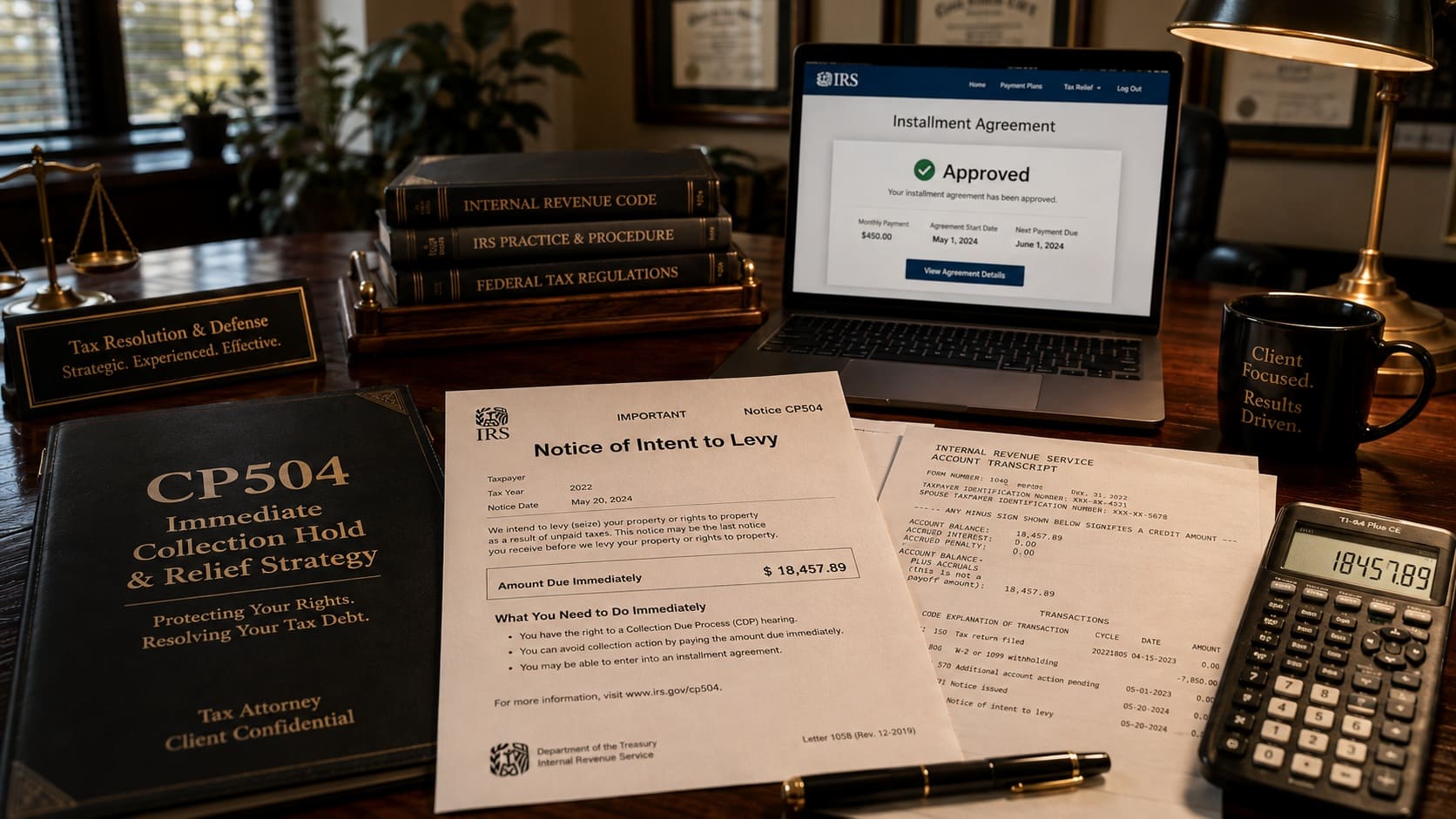
Table of Contents
- What Is IRS Notice CP504?
- What is the Reason for Your CP 504?
- A List of Assets That Are Subject to A Tax Lien from the IRS
- CP504 Can Be Dangerous to Neglect
- Tax Experts to Prevent Levy Action Quickly
- Personal Documents Commonly Requested by Experts
- Taxpayers Make These Common Mistakes
- Practical Tips After Receiving CP504
- When to Hire a Tax Attorney?
- How to avoid future IRS Collection Notices?
- FAQ
Getting a letter from the IRS is stressful, but IRS Notice CP504 is one of the most serious of all collection notices that can be sent to taxpayers. This letter is different from previous ones sent as reminders because it tells you that if you don’t settle your tax debt quickly, the IRS is going to “levy” certain assets. CP504 is not an indication that the IRS has taken your wages or bank account, but rather it indicates that the collection process is proceeding and action needs to be taken now.
Fortunately, a CP504 notice isn’t the end of the world. By knowing IRS tax procedures, a tax professional can successfully assist taxpayers in blocking levy action daily by knowing what relief programs are available and responding in advance to avoid enforcement action.
In this guide, we’ll tell you what IRS Notice CP504 is, why you have received it, how professionals prevent IRS levy actions, and what you should do immediately.
What Is IRS Notice CP504?
IRS Notice CP504 is an IRS notice of intent to levy that is sent when a taxpayer still has an outstanding federal tax debt although various IRS collection notices have been sent.
The notice tells you that:
- You have a great deal of unpaid tax debt.
- If you don’t pay, the IRS plans to seize some assets.
- Your state tax refund could be garnished by the IRS!
- Further penalties and interest are charged.
- There is an urgent need for action to stop further collection.
CP504 is a big warning; however, it’s not the Final Notice of Intent to Levy that is required prior to many kinds of IRS levies like wage garnishment or bank account levy. But when CP504s are ignored, they elicit more aggressive enforcement.
What is the Reason for Your CP 504?
This notice might be issued for several reasons:
- Unpaid income taxes
- Failure to respond to previous IRS notices
- Failure to fulfil agreement payments
- Balance due following an audit
- Errors or underreporting of income which leads to assessment of extra taxes
- If you don’t pay self-employment taxes
CP504 is generally preceded by several previous notices asking for payment.
A List of Assets That Are Subject to A Tax Lien from the IRS
Many taxpayers incorrectly think that after receiving CP504, the IRS will freeze their bank accounts. In practice, the collection process is customized to meet the needs of each situation.
Examples of assets that might be liable for levy are:
- State income tax refunds
- Bank accounts
- Wages
- Social Security benefits (on a condition basis)
- Certain retirement income
- Business receivables
- Rental income
- Financial assets other than the ones mentioned above
Most of these assets are not subject to any other legal process by the IRS before it can impose a levy.
CP504 Can Be Dangerous to Neglect
Failure to adhere to this notice can result in a lot bigger financial issues.
Possible consequences include:
- Additional penalties
- Daily interest charges
- Filing a federal tax lien.
- Bank levy
- Wage garnishment
- Seriously delinquent tax debt is certified for passport applications (in situations where legal requirements are fulfilled)
- Increased collection activity
As the delay between the balance continues, fewer options are available.
Tax Experts to Prevent Levy Action Quickly
A seasoned tax attorney does not contact the IRS and request extensions. Rather, they examine the financial standing of the taxpayer and figure out the very best remedy that can be provided.
The following are the most typical methods.
- Check the Tax Debt
The first thing to do is to verify the IRS balance.
Professionals review:
- IRS account transcripts
- Filed tax returns
- Penalty calculations
- Interest assessments
- Missing payments
- Identity theft indicators
There are often mistakes made, and corrections can take a lot out of the balance.
- Request Collection Holds
In suitable circumstances, experts will seek temporary collection holds.
The IRS will suspend collection during:
- Financial information is reviewed
- All tax returns are submitted when required.
- Installment agreements are handled
- In Compromise applications are addressed
- Hardship claims are investigated
Although not automatic, collection holds often provide valuable time.
- Set up an Installment Agreement
There are many people who are able to pay the bills every month.
Benefits include:
- Reduced collection pressure
- Prevention of numerous levy actions during the period of the agreement’s existence and good standing.
- Predictable monthly payments
- The power to settle large balances over time.
It is crucial to make the payments on time after the agreement has been approved.
- Request Currently Not Collectible Status
If payment of taxes were to leave you unable to pay basic living expenses, the IRS might consider your account as Currently Not Collectible (CNC).
This can temporarily put collections on hold while you are experiencing financial hardship.
These requests are accompanied by comprehensive accounting information, prepared by tax experts.
- Submit an Offer in Compromise
There are some taxpayers who are able to negotiate with the tax authorities for a settlement of less than the taxes due.
The IRS takes into account the following:
- Income
- Expenses
- Equity in assets
- Future earning potential
- Overall ability to pay
Not all are eligible, and the importance of professional evaluation before an application is made.
- Correct Missing Tax Returns
Numerous levy cases are related to the failure to file returns.
Experts help taxpayers:
- Prepare delinquent returns
- Substitute IRS evaluations for IRS evaluations.
- Reduce assessed balances
- Re-establish eligibility for payment programs
Filing required returns may bring other relief possibilities.
- Request Penalty Relief
Penalties could add up to a significant amount to the account balance.
In some cases, taxpayers may be eligible for:
- First-Time Penalty Abatement
- Reasonable Cause relief
- Administrative corrections
Minimizing penalties can help make repayment much more manageable.
Personal Documents Commonly Requested by Experts
Tax professionals will request:
- IRS notices
- Tax returns
- Wage information
- Bank statements
- Monthly expense records
- Details of mortgage or rent.
- Asset documentation
- Business financial records (if applicable)
Comprehensive documentation helps resolve issues quickly.
Taxpayers Make These Common Mistakes
Don’t make these costly mistakes:
- Ignoring IRS mail
- Missing response deadlines
- Getting into debt arrangements they can’t afford
- Taking money out of retirement funds without expert counsel
- Failure to file up-to-date tax returns.
- Assuming the IRS will “forget” the debt
- Allowing wages to be garnished before seeking help.
The most options for resolution typically come from taking action early.
Practical Tips After Receiving CP504
If you’re new to the notice, do the following right away:
- Carefully read the notice.
- Check tax years involved.
- Match up IRS balance to records.
- Collect previous IRS letters.
- Fill in tax returns.
- Estimate the amount of money that can be paid in full.
- Explore IRS payment options.
If the balance is substantial or collection seems to be underway, get advice from a competent tax specialist.
When to Hire a Tax Attorney?
If the professional assistance is going to be worthwhile, then:
- You have a substantial tax debt.
- There are several tax years involved.
- The IRS already has a lien.
- You’re self-employed.
- You own a business.
- You’ve been sent a few collection notices from the IRS.
- You do not have the means to pay monthly installments.
- You suspect that the amount of taxes shown on the IRS balance is wrong.
Having an experienced representative can assist you with intricate IRS operations and prevent undue delays.
How to avoid future IRS Collection Notices?
If you have an outstanding issue that’s been resolved, start doing the right things to prevent future collection efforts.
Here are some best practices to keep in mind:
- Submit all tax returns in a timely fashion, even if the amount due cannot be paid at the time.
- Make sure that tax withholding or estimated payments aren’t underpaid in the future.
- Maintain good bookkeeping, including income, deductions, and payments.
- Quickly review and act on IRS correspondence.
- Check out your tax account regularly for unanticipated balances.
- If you are having financial difficulties, call the IRS before you receive a collection notice.
- If you already have an installment agreement, make sure that you stay on top of your payments.
- Consult a competent tax professional when significant life changes—such as when you start a business, sell property, or change your job—may impact your taxes.
Preventative measures are going to be much cheaper than having forced IRS collection procedures later.
IRS Notice CP504 is a notice that should not be overlooked. It’s a sign that the IRS is going to take action that’s more severe, but it’s also a chance to get your tax debt under control before the more serious collection action is taken.
Tax professionals will first check the debt, evaluate your finances, and discuss the best way to resolve it: an installment agreement, hardship relief, an Offer in Compromise, penalty abatement, or something else. Taking swift action may be helpful in preserving your assets, minimizing penalties, and achieving a more manageable resolution.
Don’t let the situation get worse if you have been issued a CP504 notice. Knowing what choices you have and acting swiftly can be a key difference between a resolution that is successful and expensive IRS enforcement.
FAQ
1. How much time do I have to respond to IRS notice CP504?
Immediately after receipt of CP504, respond as soon as possible. The IRS will pursue further collection on the delinquent debt, impose further penalties and interest, and more. Be sure to read the notice thoroughly, and reach out to the IRS or a tax expert right away.
2. Can we setup a payment plan after receiving CP504?
Yes. After receiving CP504, there are many taxpayers who are eligible for an IRS installment agreement. If approved and kept in good standing, a payment plan can prevent further collection actions as you work toward paying off your tax debt.
3. Will the IRS remove penalties if I receive the CP504 notice?
Possibly. If you are a first-time penalty abater, you may be eligible for a First-Time Penalty Abatement or a reasonable cause penalty relief. Rates are evaluated on an individual basis; therefore, eligibility will be based on the history of compliance and the reason for the unpaid balance.
4. Should I hire a professional?
When a tax debt is significant, has multiple years of unpaid taxes, or is too large to pay in full, tax professionals can help you strategize your way through relief and communicate with the IRS before collection actions take place.
5. Can an IRS notice affect my credit score?
The notice will not affect your credit score directly. Because the federal tax lien may arise in the future if the IRS files a federal tax lien or takes other collection action, however, it could also cause other financial issues that may impact borrowing and other financial transactions indirectly.

 800-900-4250


