



Why are Businesses Facing a Sudden Tax Wall in California?
On: March 30, 2026
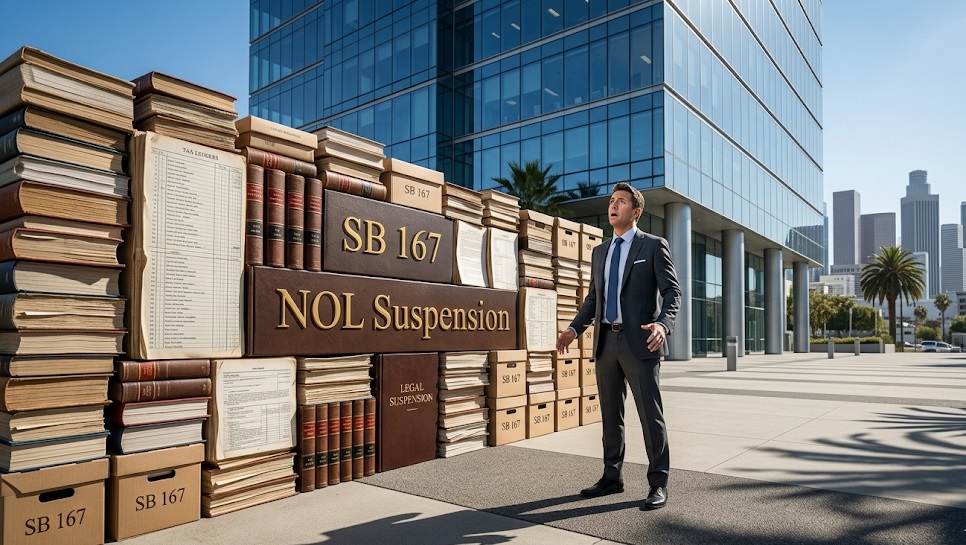
Table of Contents
- What is SB 167?
- Understand the mechanics behind the problem
- The Hard Numbers:
- What are the long-term impacts?
- This is why this puts up a tax wall:
- Who is most vulnerable?
- Tips that will help during navigating the suspension
- Optimize Current Annual Expenses
- Revise Company Organization and Accounting Procedure
- Direct the 1 Million Dollar Threshold
- Estimated Tax Payments
- Consult a Tax Professional
-
FAQ
- 1. Who is affected by the NOL suspension under SB 167?
- 2. How to carry forward suspended NOLs to the future tax years?
- 3. Will the suspension apply to both state and federal taxes?
- 4. What will happen when the income dips below $1 million during a particular year?
- 5. Which industries are exempt from the suspension?
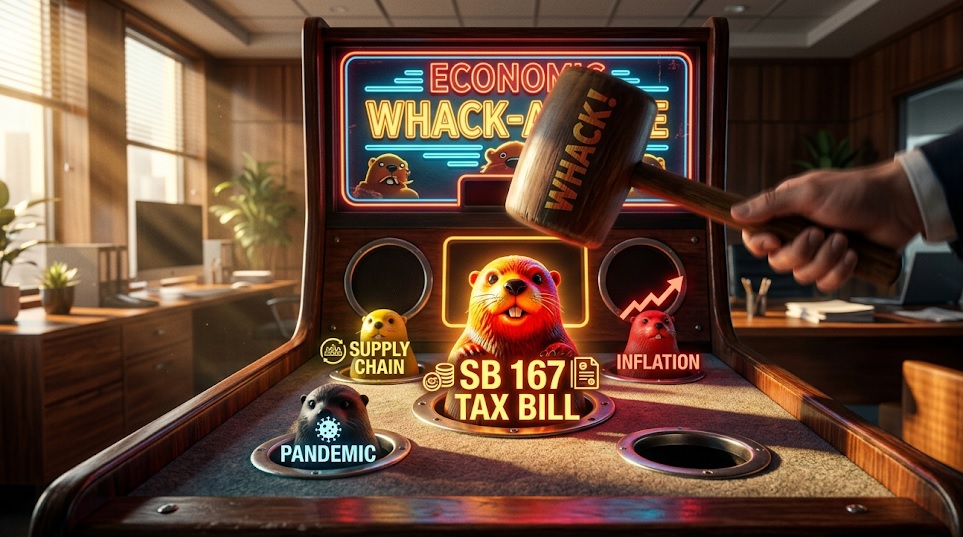
Over the past few years, the owners of small and medium-sized businesses in California have been engaged in a game of economic whack-a-mole in which they compete against each other on high stakes. When the world was starting to settle down in supply chain concerns, and the pandemic panic was waning, an additional challenge came up, and this time, not brought by the market, but by the state legislature.
In case you are a business owner, and you finally made a profit in 2024, after years of reinvesting or recovering, you might find yourself in another shock when you file your taxes. With a new legislative change, SB 167, many of the profitable businesses are hitting a semiawat in terms of taxes, which are leaving bills that are much higher than they had budgeted.
This is what you should know about the suspension of Net Operating Loss (NOL) deductions, their effect on your bottom line, and what you can do about it prior to the tax year of 2026.
What is SB 167?
California passed Senate Bill 167 (SB 167) in a bid to tackle the issue of budget deficits. Although the bill addresses various tax-related issues, the best part that hurts the small business community is that the Net Operating Loss (NOL) deduction is being suspended.
California has limited the ability of businesses to offset the current taxable income by past losses very severely in tax years 2024, 2025, and 2026.
Understand the mechanics behind the problem
In order to see why this is so much of a gut punch, we must examine how NOLs generally operate. In normal years, when a business had a bad year, such as it made a loss of 200,000 in 2023, the business could carry forward the loss to offset future years. This is an adjustment mechanism that helps to smoothen the tax load with time, in recognition that business is not necessarily linear.
In SB 167, this mechanism is practically inactivated for a group of businesses.
The Hard Numbers:
- The Threshold: When your business has taxable income of 1 million or above, then you are not allowed to claim a Net Operating Loss deduction.
- The Timeline: It is applicable to 2024, 2025, and 2026 tax years.
- The Exception: The exception applies to very small businesses (those whose income is less than 1 million) that are not subject to suspension. But once you pass that mark of $1 million–even a bare escape–you are deducted altogether.
What are the long-term impacts?
You might be wondering, why are we weeping over a tax bill when we are doing business of more than a million dollars? The solution is in the environment of the prevailing economic conditions.
We are now in the era of middle economic growth. Several of the small and medium-sized businesses (SMBs) are just beginning to recover to the revenue levels of 2020. They are not all wealthy; they are just catching up.
This is why this puts up a tax wall:
a. Cash Flow Mismatch
A company may have an income of 1.2 million that is taxable, but is still recovering the losses of 500,000 in the preceding year. In a normal tax ruling, they would deduct that to $700,000 of taxable income. They are liable to taxes on the entire amount of 1.2 million under SB 167.
b. No Liquidity on the Liabilities
Most SMBs reinvest their cash flow into stock, payroll, or capital improvements. They were using the NOL deduction so that they would manage the tax liability. In its absence, they will have tens of thousands of higher tax bills than anticipated, and no ready money to pay them.
c. Retroactive Feel
Although the law was enacted in advance, the economic fact is that most businesses have made hiring and investment decisions based on the pro-forma tax planning that NOLs would be accessible.
Who is most vulnerable?
Not all industries are impacted by this suspension in a similar way. The most strained businesses at the moment are likely to be:
1. Manufacturing
High capital expenditure (CAPEX), where there is a tendency to incur losses within initial years, which offset the subsequent profitability.
2. Restaurants & Hospitality
The sector experienced huge losses during closures. However, as the foot traffic grows, it is at last profitable, just in time, when the deduction is removed.
3. Tech Startups (S-Corps)
Most startups operate at a loss during the scaling. They are receiving full taxation on the verge of becoming profitable without the benefit of their losses as a buffer.
4. Real Estate / Construction
This industry will experience varying profits and losses due to volatile markets; this suspension comes at the worst time possible during recession periods.
Optimize Current Annual Expenses
- Accelerate Expenses: When you are considering a large equipment purchase in the year 2026 or 2027, you should consider making the purchase before the current tax year ends.
- Section 179: Use Section 179 expensing to expense all the costs of qualifying equipment (such as vehicles or machinery) in the year it is placed in service, not to depreciate it. This reduces your taxable income up to the 1 million mark as much as you can.
Revise Company Organization and Accounting Procedure
- Cash vs. Accrual: With accrual accounting, you can change to cash accounting, so you do not report the income that is due until the cash is actually received, and this may make your taxable income lower during the year.
- Retirement Contributions: The most effective method of reducing the taxable income is to maximize owner and employee retirement plan contributions (SEP IRAs, Solo 401(k)s).
Direct the 1 Million Dollar Threshold
As the suspension becomes effective on the taxable income that passes its 1 million mark, keeping within the 1 million mark can be a major savings plan on the tax front. In case you are expected to make 1.05 million, it is possible to spend 50001 on some needed business expenses (or income postponements) to make less than the limit and regain your NOL deduction ability.
Estimated Tax Payments
Check your Q3 and Q4 expected tax payments, which you have not done yet. The fines for underpayment in California may accumulate very fast. When you know that you will lose the NOL deduction, you’d better make more estimates payments in the present so that you do not pay the interests in the future.
Consult a Tax Professional
It is not a self-help tax year. The contact between the Federal NOL rules (that are now different) and the suspended rules of California is intricate. You can use a qualified CPA or EA to do projections to determine whether it would be more reasonable to accelerate expenses or defer income to meet your unique cash flow requirements.
The suspension of SB 167 is now expected to be lifted once the tax year 2026 begins. In the meantime, the owners of businesses have to accept it as the new normal in the immediate future.
When you are having a bigger tax bill than you expected this year, keep in mind that you are not alone. Thousands of California companies are bumping up against the same wall. The point is to change the reactive position to a proactive one. With a heavy hand on your taxable earnings and the use of allowable deductions, you can literally ride through this suspension without causing irreparable damage to your business in the long run.
FAQ
1. Who is affected by the NOL suspension under SB 167?
The deductions on Net Operating Losses cannot be used by any business that has taxable income of more than 1 million in tax years 2024, 2025, or 2026. This is irrespective of the industry or type of entity, but sole proprietors, partnerships, S-corporations, and C-corporations are all affected as long as they reach the threshold.
2. How to carry forward suspended NOLs to the future tax years?
Yes. Although you cannot deduction deductions on the suspension years (2024-2026), there is no loss of losses. Those would be available to be carried over and used once the suspension has been lifted in 2027, unless there are legislative changes.
3. Will the suspension apply to both state and federal taxes?
No. This is suspended only on California state income taxes. The Federal Net Operating Loss regulations are independent and tend to be lax. Make sure to also work with your tax professional in order to differentiate between your state and federal.
4. What will happen when the income dips below $1 million during a particular year?
The suspension is not applicable in a tax year in which your taxable income is less than the 1 million threshold between 2024 and 2026. However, you can take a deduction of your available NOL during that particular year despite reaching the threshold in the previous years.
5. Which industries are exempt from the suspension?
There are no extensive industry exemptions. Nonetheless, companies with revenue less than one million are automatically not subjected to it. Also, some small businesses damaged due to qualifying disasters can obtain separate relief; however, it is done on a case-by-case basis via certain disaster loss provisions.

 800-900-4250


